
FSMA 204: Why Your Own “Private Traceability List” Matters
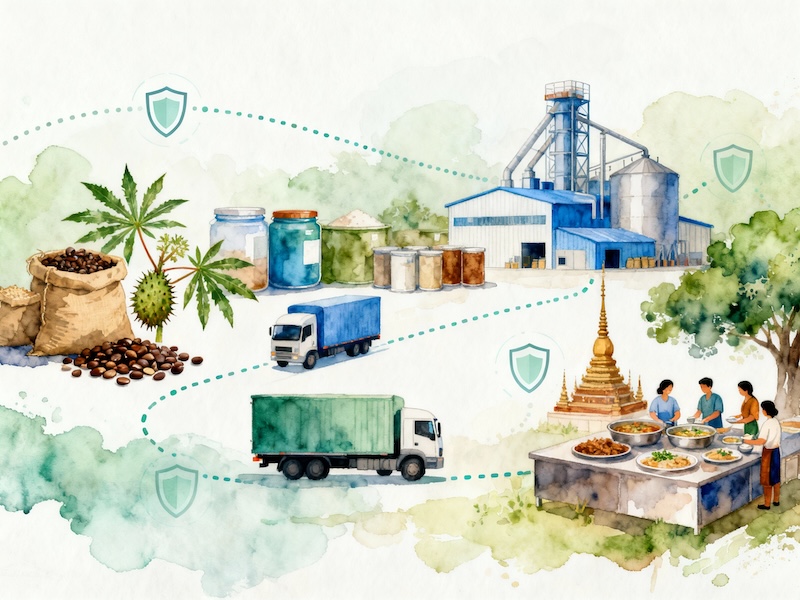
When a common plant becomes a weapon
In November, investigators in India said they had foiled a plot to extract ricin from ordinary castor seeds and use it to poison food served in religious settings. The alleged plan did not rely on explosives or guns; it relied on turning something that looked like a normal input to the food system into a silent delivery mechanism for a highly lethal toxin.
It is a stark reminder that modern supply chains move materials that are not just “ingredients” in the narrow, regulatory sense, but—in the wrong hands and context—potential instruments of mass harm.
FSMA 204: Essential, but narrow
The FSMA 204 Food Traceability Rule focuses on a defined Food Traceability List (FTL) of higher‑risk foods, requiring additional records for those items so they can be traced and removed quickly in an outbreak. This is a major step forward for classic food safety and recall speed, but the scope is intentionally limited to foods selected using historical outbreak and illness data.
Ricin and castor by‑products are not on that list, yet they reportedly sat at the center of a plan to contaminate food in places of worship. From a brand and public‑safety perspective, the risk is not defined by whether something appears on FDA’s FTL; it is defined by what can reach consumers, and what could be turned into a vector for harm.
Intentional adulteration and the visibility gap
FSMA already addresses deliberate harm via the Intentional Adulteration (IA) rule, which requires covered facilities to identify “actionable process steps” and adopt mitigation strategies against acts meant to cause wide‑scale public health impact. That framework is vital for food defense, but it does not automatically give FSMA‑204‑style, lot‑level traceability to every ingredient, intermediate, or by‑product that might be misused.
If a company stops at “we meet FSMA 204 and we have an IA plan,” it may still be accepting very uneven visibility: FTL items are highly traceable; many other materials are not, even though they could just as easily be diverted, substituted, or weaponized.
Building your own “private FTL”
A more realistic posture for today’s risk landscape is to treat FSMA 204 as the floor, not the ceiling. Regulation says: apply enhanced traceability to the public FTL and maintain standard records for everything else. A stronger approach says: for this brand, every ingredient, intermediate, and critical input that can reach a consumer—or that could be misused along the way—deserves FTL‑grade visibility.
Practically, that means creating an internal “private FTL” that sits alongside the FDA list and drives your own traceability design:
• Every ingredient and key input gets a robust digital identity that links to supplier, lot, and upstream events, not just those on the public FTL.
• Key data is captured at all major handoffs—who, where, when, how—in a way that can be searched in hours, not days.
• Recall, investigation, and root‑cause workflows can run on non‑FTL materials with the same speed and confidence as on FTL foods.
From a consumer’s point of view, there is no “low‑priority” ingredient when it ends up in a family meal, a school lunch, or food served in a place of worship.
Digital, AI‑driven risk mitigation
Making this practical requires more than thicker binders of SOPs; it needs continuous, digital scrutiny woven into existing critical tracking events: when materials are packed, loaded, consolidated, handed off, received, processed, and prepared. At those touchpoints, quick scans and captures—photos, short video, sensor readings—linked to item‑ or batch‑level identities (QR codes, serialized IDs, or similar) can quietly answer: “Is this what we think it is, in the state we expect, going where it’s supposed to go?”
When growers, processors, carriers, importers, distributors, foodservice operators, and retailers all add these small, time‑stamped pieces of evidence at their own critical steps, they effectively co‑author a risk narrative for every lot. That makes it much harder for accidental contamination, fraud, or deliberate tampering to slip through unnoticed—and shrinks the window between “something happened” and “we know where and how.”
The real question for brands
The ricin plot in India belongs in food‑industry conversations not because every supply chain is on the brink of bioterrorism, but because it shows how thin the line can be between “normal ingredient” and “vector of harm” when visibility is shallow. FSMA 204 raises the floor for certain high‑risk foods; the brands that will earn and keep trust are the ones that quietly go further, building private FTLs and modern, AI‑enabled traceability that cover everything they touch, not just what the regulation names.
For consumers, the question becomes: who is just “checking the FSMA 204 box,” and who is using it as a starting point to close the blind spots that incidents like the ricin case have already revealed?
Further reading
Times of India – Glock pistols, castor oil, and a toxic poison probe
Deccan Herald – Hyderabad ricin terror plot details
Awaz The Voice – No antidote for ricin, bioterror threat
India Today – Gujarat ATS foils chemical terror plot
FDA – FSMA 204 Food Traceability Final Rule
FDA – Food Traceability List (FTL)
IFDA – FSMA 204 Manual for Food Distributors
Trustwell – Guide to the Food Traceability Final Rule
FoodDocs – How to Meet FSMA 204 Compliance
FDA – FSMA Intentional Adulteration Final Rule
FDA – Draft Guidance on Mitigation Strategies
SafetyChain – Guide to the FSMA IA Rule
FoodReady – How Traceability Builds Consumer Confidence
PRISM – AI‑Driven Food Traceability Scenario
PMC – Overview of Food Preservation and Traceability Technology