
When Containers Lie: How Importers Can Stop Paying For Other People’s Shortcuts
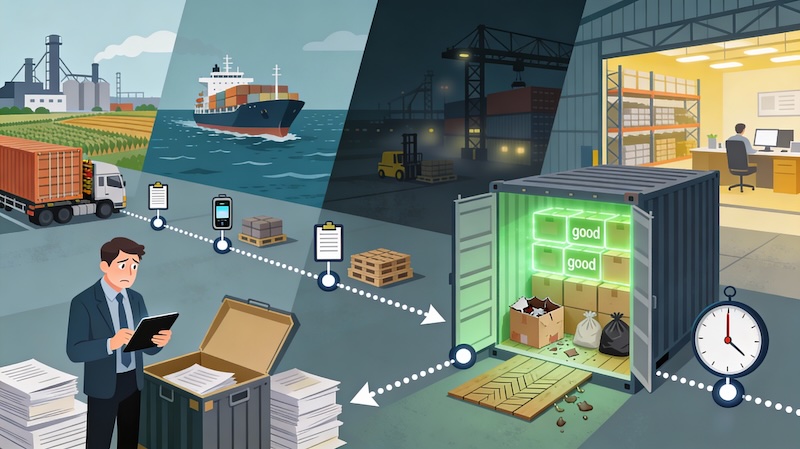
When a container finally reaches an importer’s dock, months of upstream promises and paperwork turn into something brutally simple: what is actually inside those boxes. For both construction materials and food, that moment is where risk becomes real. If the goods are wrong, quietly downgraded, or unsafe, it is almost always the importer who discovers it first—and pays the price.
The Hidden Risk Behind “Approved” Suppliers
On paper, many sourcing stories look clean. A reputable supplier, a vetted factory, approved samples, contracts signed, quality specs agreed. The first shipment looks great. Then orders scale up, the relationship settles into routine, and something shifts—quietly.
This is where quality fade enters. In many low‑cost manufacturing hubs, a recurring pattern is that a supplier wins business with a perfect “golden sample” and early batches from their best line, then gradually cuts costs.
That cost cutting can come from:
- Moving most production to cheaper sub‑factories or night shifts.
- Swapping to lower‑grade core materials or adhesives.
- Relaxing process controls on thickness, density, or finishing.
From the importer’s side, the brand, product code, and paperwork may all look unchanged. But when that flooring goes down on a job, it suddenly behaves like two different products: a small fraction seems to perform like the original flagship material, and the rest feels like it came from a totally different, lower‑tier facility.
By the time anyone notices?
- The container is cleared.
- The material is in warehouses or on site.
- The importer owns it—and owns the problem.
Food Imports: The Same Story, With a Shorter Fuse
Food behaves the same way, just faster and with more at stake. Recent inspection data from major markets show that imported fruits, vegetables, spices, and other plant‑based foods can fail checks for residues, contaminants, microbes, and labelling in non‑trivial numbers, even as overall compliance in inspected lots remains high.
That does not mean a large share of all food imports is bad. It means:
- Regulators test only a fraction of all shipments.
- Within those tested samples, enough failures occur to justify ongoing, intensive checks.
And outside regulatory sampling, many real‑world issues are ultimately discovered by:
- The importer’s own incoming inspections.
- Retailers who notice shelf‑life failures or spoilage.
- Consumers who experience quality or safety problems.
Minor changes upstream—different farms, different packers, slight shifts in washing or cold‑chain handling—can dramatically change shelf life and risk, even while the SKU and paperwork remain identical. Once again, the importer is the first one to feel the consequences in full: recalls, withdrawals, chargebacks, write‑offs, brand damage.
Why “Inspect On Arrival” Is Too Late
Traditional risk management assumes a big filter at the end: you inspect when the shipment arrives. For obvious transit damage, that still matters. But for structural problems like quality fade, factory switching, or subtle process changes in food and materials, arrival inspection is often too blunt and too late.
Some of the hardest problems to detect are:
- Flooring cores that were quietly downgraded but only fail after installation.
- Coatings that look fine out of the box but discolor early in real use.
- Produce that appears acceptable at receiving but breaks down days too soon at retail.
- Spices or dried products with contamination that only shows up in lab testing.
By the time these issues are visible, the goods have:
- Been mixed into stock.
- Been distributed to multiple customers or sites.
- Slipped beyond any simple “return the container” fix.
The importer now faces a multi‑front battle: customer appeasement, technical investigations, regulatory dealings in food, and painful, often partial negotiations with suppliers and insurers. Even where customs laws allow some duty relief on damaged or defective imports, that only trims taxes—it does nothing about missed deadlines, lost projects, or consumer trust.
Treat Every Pallet As A Data Point, Not Just A Box
The pattern is clear: distance and opacity reward bad behavior and magnify honest mistakes. The importer is downstream of every choice the supplier makes and upstream of every impact on customers. The only realistic way to bend that curve is to make each unit of product carry its own traceable story.
Think of what happens when every pallet, bundle, case—or even individual consumer pack—has a unique, scannable identity tied to a shared digital record:
- At the factory, each lot is tagged as it comes off a specific line, with references to the raw‑material batches and process checks it passed (thickness, density, appearance, lab tests).
- At consolidation warehouses and ports, scans log exactly which lots are loaded into which containers, on which dates, under which conditions.
- At the importer’s dock, receiving scans verify that the same identified lots actually arrive—no silent substitutions, no invisible factory swaps.
- Downstream, if needed, scans at warehouses, retailers, or job sites link usage and performance back to those same production and handling records.
Suddenly:
- A defective flooring installation can be tied back to specific production dates and lines, not an entire supplier relationship.
- A moldy berry problem at a retailer can be connected to a particular farm or packhouse and a specific shipping window, not “all berries from that country.”
- Recalls and withdrawals can be surgically narrow, focused on affected lots instead of entire shipments or product families.
Shifting The Balance Of Power For Importers
For importers, this kind of granular traceability changes the risk equation. You no longer argue in the abstract about whether the supplier must have changed something. You point to the exact lots, factories, dates, and test results tied to problem units.
You do not have to treat every batch as a fresh leap of faith. You can continuously compare live shipments to your original benchmark “golden” batches and see if quality or origin patterns drift over time. You move from all‑or‑nothing disputes (“this entire container is bad”) to data‑driven negotiations (“these specific lots, produced in this window, failed; here is the evidence”).
And just as importantly, you can show your customers—builders, retailers, or even end consumers—that your brand is not just moving boxes. It is actively tracking what happens at critical points in the supply chain, catching problems earlier, and narrowing the blast radius when something slips through.
In a world where containers can hide a mix of top‑tier and cut‑rate goods, and where a single food incident can ripple across entire categories, importers who can see and prove what happened to each identifiable lot are the ones who stop being passive shock absorbers. They become informed gatekeepers—still exposed to risk, but far better equipped to detect, isolate, and push it back up the chain where it belongs.