
Why Food Traceability Must Go Beyond Compliance
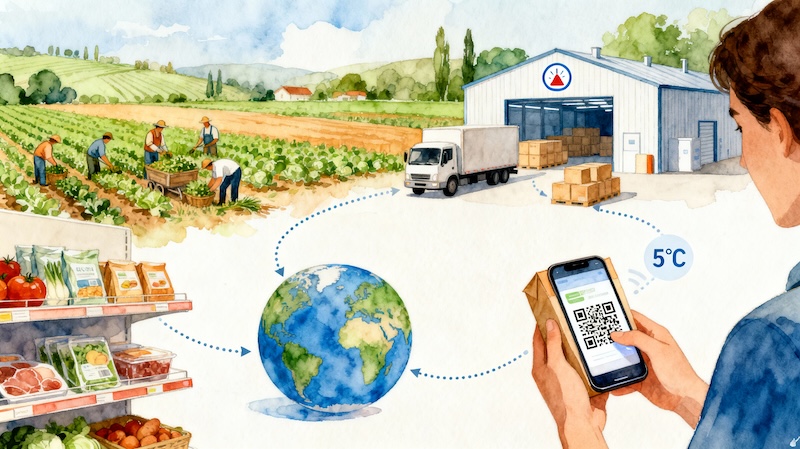
Modern rules like FSMA 204, SFCR, and FSSAI put Critical Tracking Events (CTEs) at the center of food safety, but treating them only as regulatory checkboxes wastes their real potential. Each CTE—harvest, first packing, processing, loading, handoff, warehousing, retail scanning, and the final consumer interaction—is a moment where risk, quality, and customer experience all converge.
Around every CTE is a mesh of people such as growers, drivers, warehouse staff, quality teams, store employees, auditors, and consumers who notice things that never make it into conventional traceability logs.
What Traditional Traceability Misses
Most traceability systems track where a lot moved and when, but not what actually happened to it along the way. They rarely capture visual evidence of condition at the farm or on the shelf, sensor streams like temperature and humidity, field notes from logistics and store personnel, or consumer-level feedback tied back to a specific unit and store.
Because this information is fragmented or never collected, companies often discover problems late through recalls or complaints and must respond with broad, blunt actions instead of targeted, evidence-based interventions.
Turning Every CTE Into a Smart Data Point
A smarter approach treats each CTE as a living data node that can capture multiple signals, not just a timestamp. At every event, authorized actors can scan secure QR identities for units, batches, pallets, or locations; attach photos or video of fields, trucks, pallets, shelves, and certificates; stream or upload temperature and humidity readings; and submit structured checklists or incident reports tailored to their role.
All of this flows into an AI-enabled platform, where models analyze images, sensor data, and human inputs to detect early patterns of spoilage risk, non-compliance, tampering, or supply stress that would be invisible in traditional systems.
Intelligence From Farm To Fork
When CTEs work this way, the same network built for compliance becomes a continuous intelligence fabric. Growers and field inspectors contribute proof of farming practices and hygiene, drivers and warehouse teams log authenticated handoffs with condition evidence, store staff capture shelf-level realities like poor rotation or refrigeration issues, and consumers scan item-level codes to verify authenticity and report problems linked to specific batches.
AI and rules-based logic connect these signals across thousands of events to spot recurring weak links, emerging risks, and operational drift long before they become crises.
From Traceability To Collective Intelligence
Treating CTEs as active data points rather than passive records turns traceability into a form of collective intelligence. Every scan, photo, sensor log, and comment becomes part of a tamper-evident history that enables precise recalls, proves ethical sourcing and cold-chain integrity, highlights persistent issues tied to specific suppliers or routes, and feeds business intelligence on shelf life, quality by region, and consumer satisfaction.
In this model, “true traceability” means every event, actor, and scan contributes to a shared, AI-powered understanding of risk, quality, and opportunity across the entire food value chain.
Further Reading on Food Traceability and CTEs
FDA – FSMA Final Rule on Requirements for Additional Traceability Records
FDA – Food Traceability List (FTL) for FSMA 204
FSMA 204 General Summary (Industry Overview)
NSF – FSMA 204 Traceability Rule Guidance
Walmart – Food Traceability Requirements
Transforming food supply chains through digital tracking and traceability
Overview of Food Preservation and Traceability Technology in the Food Industry
Food Traceability System Design Incorporating AI Chatbots